CALLED BY THE WORD, UNITED FOR THE MISSION
by ARCH BISHOP · January 25, 2026
3RD SUNDAY IN ORDINARY TIME YEAR A, 25TH JANUARY, 2026, ST. JOSEPH PASTORAL AREA, LUGBE ACROSS. HOMILY BY ARCHBISHOP I.A.KAIGAMA.
READINGS: IS. 8:23-9:3, 1 COR. 1:10-13, 17, MATT. 4:12-23.
THEME: CALLED BY THE WORD, UNITED FOR THE MISSION
Dear parishioners of St. Joseph Lugbe Across, I am glad to be here to celebrate today’s liturgy with you.
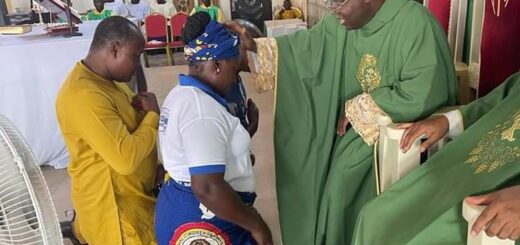
The Church celebrates this third Sunday in Ordinary Time as the “Sunday of the Word of God,” a day set aside to remind us of the central place of Scripture in the life of the Church and of every Christian. Today also marks the conclusion of the Week of Prayer for Christian Unity (celebrated every year from 18-25 January). In addition, some of your parishioners will be confirmed as soldiers of Christ, sent on mission to proclaim the word of God not only with their lips but with their lives – in daily concrete actions. I also rejoice that at this Mass, some of your parishioners will receive the Sacrament of Matrimony.
Indeed, blessed are you, parishioners of St. Joseph Lugbe Across!
I commend your spirit of family and collaboration under the pastoral leadership of your Priest, Fr. Oliver Buba. May your unity, nourished by the word of God, continue to bear abundant fruit. Amen.
As this Sunday coincides with the end of the “Week of Prayer for Christian Unity” and as we live in a generation marked by Christian divisions along denominational lines, the word of God must become our binding force. St. Jerome’s popular saying rings true: “Ignorance of Scripture is ignorance of Christ.” When we ignore the Scripture, we ignore one of those pillars on which the Church stands, and we cannot grow in unity, holiness, or true knowledge of God.
During this week, Christians of the various confessions worldwide pray and reflect on the same biblical texts, seeking to become a people formed by the Word, united in Christ, and sent on mission in a world increasingly shaped by secularism and anthropocentric rather than theocentric values.
St. Paul, in the second reading, calls passionately for unity. The Christian community in Corinth was deeply divided, each group idolizing a particular preacher.
St Paul responds to the crisis in the Church in Corinth by directing their attention to Christ crucified. He expressed his disappointment over the conduct of the Corinthian Christians and rebuked them for their divisive behaviour. Paul appealed for harmony because where Christ is truly present, there must be a spirit of unity, solidarity, and collaboration instead of division and rivalry.
The more the world continues to over-emphasize racial differences and class discrimination, the more, as Christians, we must boldly remind the world that there is only one race that matters, and that is the human race. Let us build strength from our diversity. As St. Augustine wisely said: “in essentials, unity; in non-essentials, liberty; in all things, charity.”
The purpose of declaring this third Sunday of the year as the Sunday of the Word of God is to emphasize that the bible is not just an ancient book but the living Word of God that speaks to us daily. The Bible contains the stories of God’s faithfulness, His mercy, and His desire for our happiness. It is through reading and meditating on the Word of God that we deepen our relationship with Jesus and grow in faith. As Jesus Himself often quoted Scripture to teach and confront, so too are we invited to immerse ourselves in God’s Word, allowing it to shape our hearts, minds, and also influence our actions.
Let me ask you honestly: How often do you read the Bible? You shouldn’t be surprised that some people don’t even own a Bible at home. Others cannot remember where theirs is kept. Yet this Word is our light and guide.
In the first reading today, the Prophet Isaiah offers hope to a people who had known suffering and humiliation. The lands of Zebulun and Naphtali (old names for Galilee) had been ravaged by the Assyrians. Yet Isaiah proclaimed hope. He foresaw a reversal in their fortunes: “The people that walked in darkness has seen a great light; on those who live in the land of deep shadow a light has shown… they rejoice before you as with joy at the harvest” (Is. 9:2-3). St. Matthew later recognized this prophecy fulfilled in Jesus, who began His ministry in Galilee.
In today’s liturgy, the Evangelist Matthew presents the beginning of Christ’s public ministry. It consisted essentially in preaching the Kingdom of God and healing the sick, showing that this Kingdom is close at hand and is already in our midst.
Significantly, Jesus began His mission in Galilee, not a religious or political centre, but a neglected region. This reminds us that God often chooses what the world overlooks.
The Kingdom of God, which Jesus preached, did not refer to a geographical territory but to God’s active and loving reign in human history.
In today’s gospel, after John’s arrest, Jesus went to Galilee. This detail is important because Galilee was not a center of power or religion. It was a place often ignored, yet Jesus went there to bring them to the light. The “Good News” which Jesus proclaims is summed up in this sentence: “The Kingdom of God – or Kingdom of Heaven – is at hand” (cf. Mt 4: 17; Mk 1: 15). What do these words mean? They do not, of course, refer to an earthly region marked out in space and time, but rather to an announcement that it is God who reigns, that God is Lord, and that His lordship is present and actual, it is being realized. The newness of Christ’s message, therefore, is that God made Himself close in Christ and now reigns in our midst, as the miracles and healings that He worked demonstrated. God reigns in the world through His Son made man and with the power of the Holy Spirit, who is called “the finger of God” (Lk 11: 20). Wherever Jesus goes, the Creator Spirit brings life, and men and women are healed of diseases of body and spirit. God’s lordship is thus manifest in the healings and miracles.
By this, Jesus wanted to reveal the face of the true God, the God who is close, full of mercy for every human being; the God who makes us a gift of life in abundance, His own life. The Kingdom of God is therefore life that asserts itself over death, the light of truth that dispels the darkness of ignorance and lies.
Preaching the message of repentance is an urgent and important message for us because we live in a society that is so polarized along political, religious, and ethnic lines. We must learn to rise beyond the little things that divide us, so as to embrace and appreciate those basic things that unite us. With our individual behaviour, unique talents, and distinctive attributes, each one of us is needed to enrich the Kingdom of God; to bear witness to the gospel message.
Going on to call His first disciples, Christ called fishermen and not the most intelligent or the richest people.
This does not mean He hates educated or rich people, but that He is willing to accept any and every one of us, irrespective of our status. He called them, and immediately they left whatever they were doing and followed Him. Leaving the net and following Christ means leaving our worries, our fears, our bad habits, our resentment, our pride, our selfishness, our old ways of life; it means letting go of everything that keeps us away from God and saying “Yes” to Him, through our lifestyle. Today’s gospel invites us to hear Jesus calling our names, Philip, Andrew, Agatha, Chioma, Zainab, Tunde, and so on, to trust in Him and follow Him. He calls us to a mission to bring the light of Christ to cover the earth, as water covers the earth, to carry faith to the doubting, hope to the fearful, strength to the weak, and comfort to the mourners. It is a mission entrusted, not just to the apostles, bishops, and priests, but also to the laity who serve in the Church as altar servers, readers, Eucharistic ministers, catechism teachers, and so on. In fact, all the baptized and confirmed are called to be fishers for Christ.
Christ, the light of the world who illumines our hearts and shines for all, urges us to repent if we have caused divisions in His Church and unite with our fellow Christians in bringing His light to the rest of mankind.
Our apostolate will be a mighty force if it comes from one united Church. Together we can win, divided we fall. We Christians are gathered together by the same Word, joined together by the same Baptism, framed together by the same Spirit, and built together by the same Christ. Why aren’t we united in mind and heart? Scripture tells us that “The whole community of believers was one in heart and mind” (Acts 4:32).
Although the week of prayer for Christian unity ends today, we must continue to pray for unity first among ourselves as Catholics, that we may speak in harmony, and we must continue to pray that the members of different Churches may soon be bound together in the visible unity of one faith. Unity does not necessarily mean uniformity. It does not mean sameness, but it does mean faithfulness to the one Lord who calls us all.
Let us reflect honestly:
Have you visited a church other than yours during this week of prayer for Christian unity?
Do you still carry some prejudices you were fed when you were growing up about other Christians?
Are you tempted to idolize preachers instead of focusing on Christ? This is called “personality cult.”
“Is Christ divided?” This is a question each of us must answer today.
As St. Paul appealed to the people of Corinth, so I appeal to your parish, to priests, religious laity of our Archdiocese, to our politicians and to leaders of the various tribes and religions in Nigeria: “I urge you my brothers and sisters that there be no divisions among you, but that you be united in the same mind, and in the same purpose” (1 Cor. 1:10).
The division caused in our country by religious fanaticism and ethnic bigotry is hatching grievous social disorder, whereby Citizens are attacked, kidnapped, or killed in a barbaric manner on a regular basis. This terrible trend invites Nigeria and Nigerians to listen to the counsel of St. Paul, inviting us to unity and harmony.
May the Holy Spirit open our eyes to see beyond our differences so that we can enjoy the beauty in our diversity and faithfully carry out the duties entrusted to us.
Peace be with you.